
Introduction

Healthcare faces a critical juncture. Regulatory demands are increasing, digital health adoption is accelerating, and the gap between clinical workforce supply and demand is widening. Deficiencies in compliance training and leadership development are reducing the quality of care, limiting team performance, and threatening accreditation for hospitals, clinics, and pharmaceutical networks globally.
Organizations that prioritize workforce enablement as a strategic initiative are advancing in accreditation readiness, patient safety, and operational resilience. By mastering compliance and developing leadership, they gain advantages in attracting talent, retaining patients, and strengthening their market position.
This playbook offers healthcare leaders a practical approach, including the 4-Phase Clinical Mastery Framework, the 6 Essential Healthcare Leadership Domains, and effective scaling matrices for multi-jurisdiction compliance. Whether you develop solutions internally, collaborate with specialists, or combine both, the frameworks and assessment tools will help you address gaps and advance your organization’s success.
Key Insight: Organizations that implement structured clinical mastery frameworks achieve 96% compliance completion, avoid over $900,000 in penalties, and realize a 42-fold ROI within 18 months. In contrast, those using fragmented training experience 58% CPD incompletion and repeated audit failures, which negatively affect patient trust and reimbursement.
The Hidden Gaps Undermining Healthcare Excellence
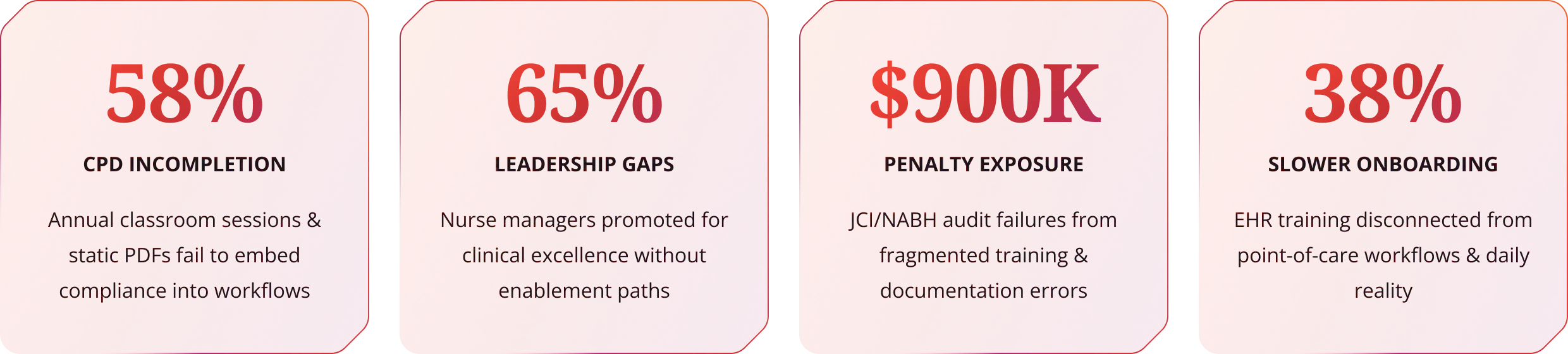
While the statistics are clear, the underlying issue is often overlooked. Healthcare organizations do not fail due to poor clinical intent; they fail because workforce enablement systems are not built to handle the speed, complexity, and scale of current healthcare regulations and digital transformation.
The 58% CPD Incompletion Crisis
Continuing Professional Development (CPD) is essential for accreditation and patient safety. However, 58% of clinicians across hospitals, clinics, and pharmaceutical networks do not complete the required CPD modules. This is not due to a lack of interest, but to structural shortcomings. Traditional classroom sessions, static manuals, and generic e-learning modules fail to integrate regulatory requirements into daily workflows. This leads to fragmented knowledge, documentation errors, and increased risk of penalties under JCI, NABH, and CQC mandates.
The 65% Leadership Gap
Nurse managers, clinical leads, and quality officers form the operational core of healthcare organizations. Yet 65% of healthcare enterprises report leadership gaps that delay promotions and leave key roles vacant. When inexperienced managers oversee accreditation audits, incident investigations, and care coordination, patient outcomes decline. The issue is not a lack of talent, but inadequate enablement pathways.
Digital Transformation Without Digital Readiness
EHR rollouts, telehealth integration, and data security requirements require teams skilled in digital adoption, interoperability, and incident response. However, frontline staff often resist new systems when training is not aligned with daily workflows. This results in 38% slower onboarding, documentation errors that lead to audit findings, and gaps in care quality that affect patient safety and efficiency.
The Patient Trust Deficit
Fragmented workforce enablement erodes patient trust, lowers HCAHPS scores, and reduces reimbursement rates. Competitive positioning also suffers in a consumer-driven healthcare market.